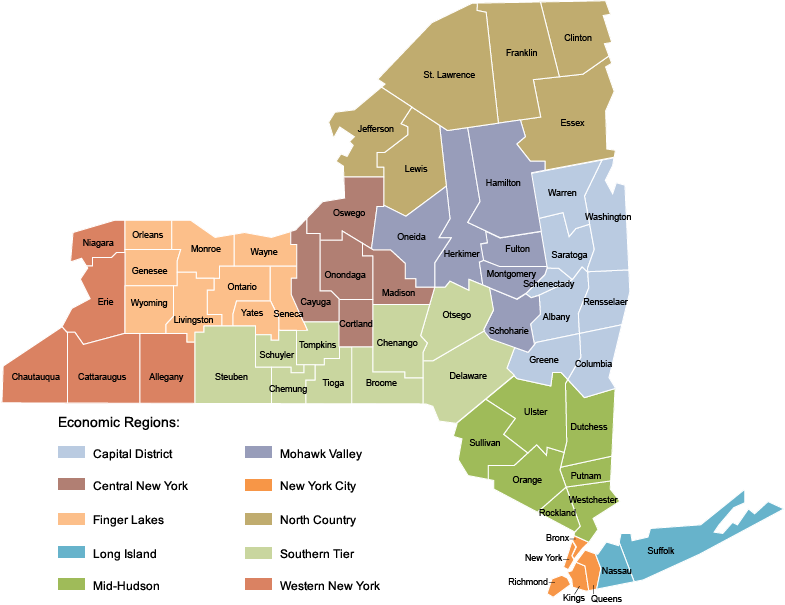
Regions Map
X
Rumbon Dance Studio
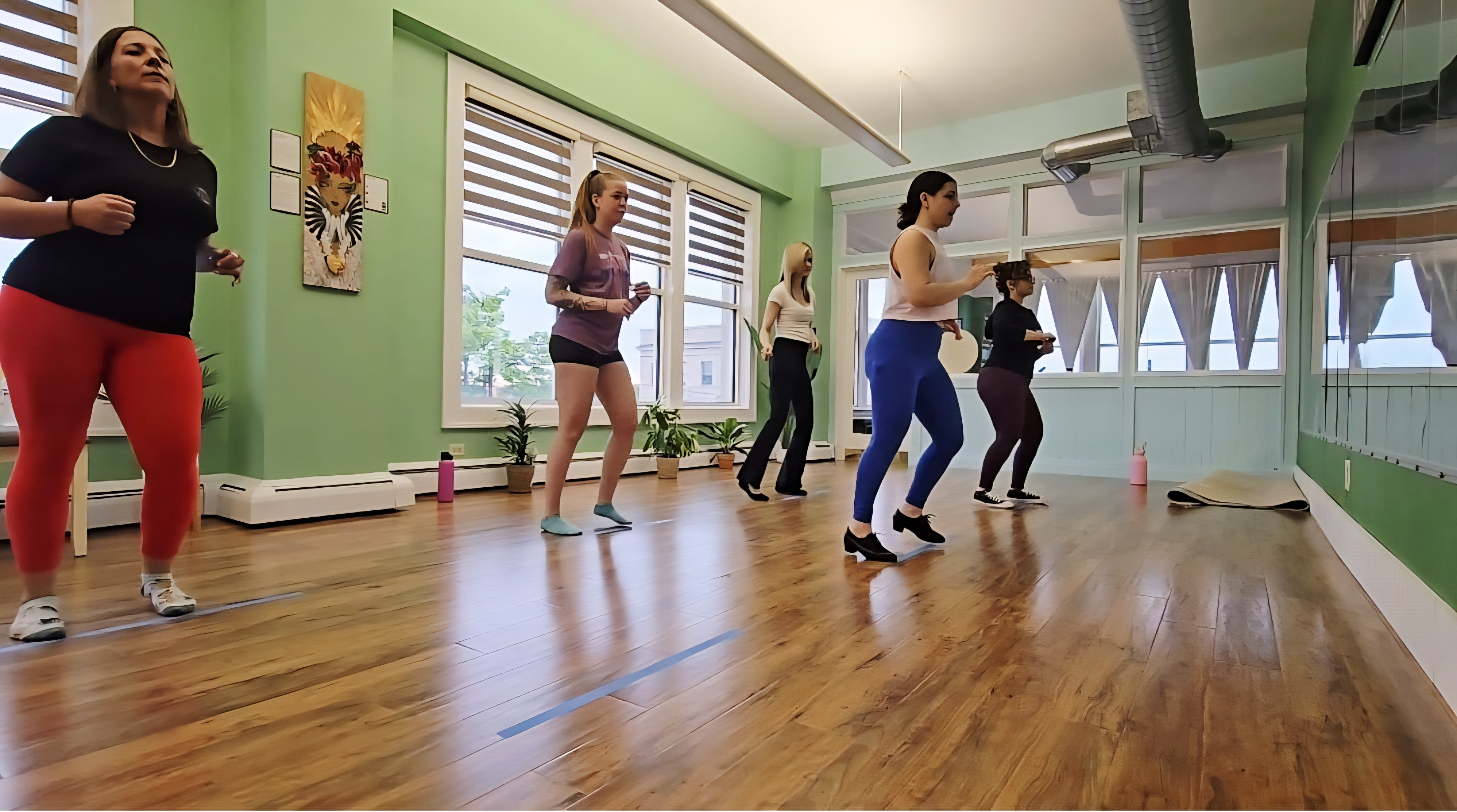
Rumbón Dance Studio, LLC is a dance studio that teaches Colombian-style salsa dance for beginner- and intermediate-level dancers. We also offer cardio classes and performance choreography in various dance styles.
Partner and solo salsa dance develop personal skills such as patience, respect, self-awareness and emotional expression, physical skills such as balance and stamina, and musical skills such as rhythm and phrasing. Workshops and classes are perfect for work with students in school musicals, ice-breaker, team-building or social-emotional learning activities, after-school programming, as well as staff development and events.
Trainor Dance
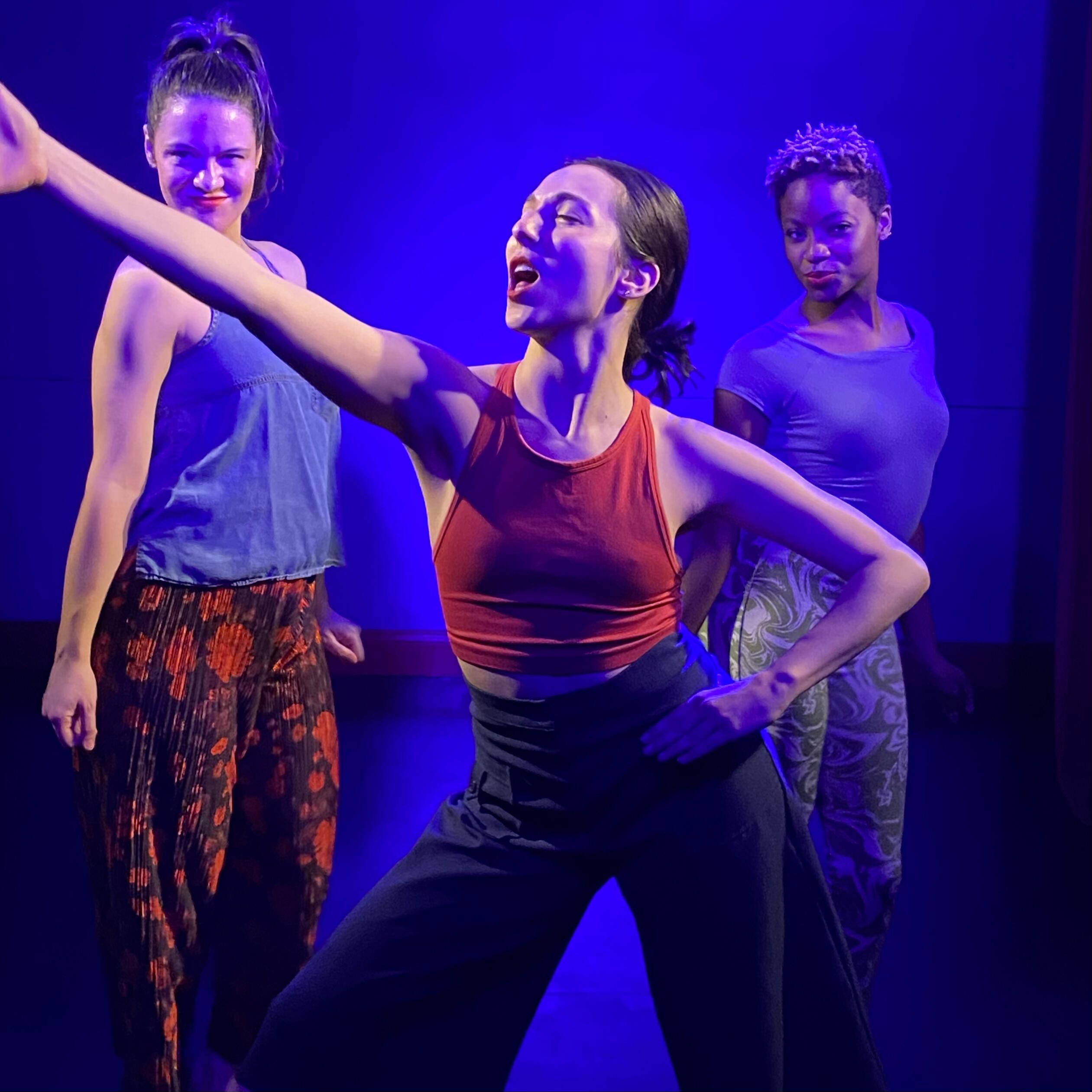
In "Fact or Fiction" performers tell stories through dance. Are they true? The audience decides! The show is a ton of fun, with an electrifying cast and a ton of heart! Audiences laugh, maybe cry, and definitely have something to talk about after the show. We bring the auction paddles for voting; you bring the students! This show has inspired multiple offshoot projects amongst students and teachers.
Hugos Art
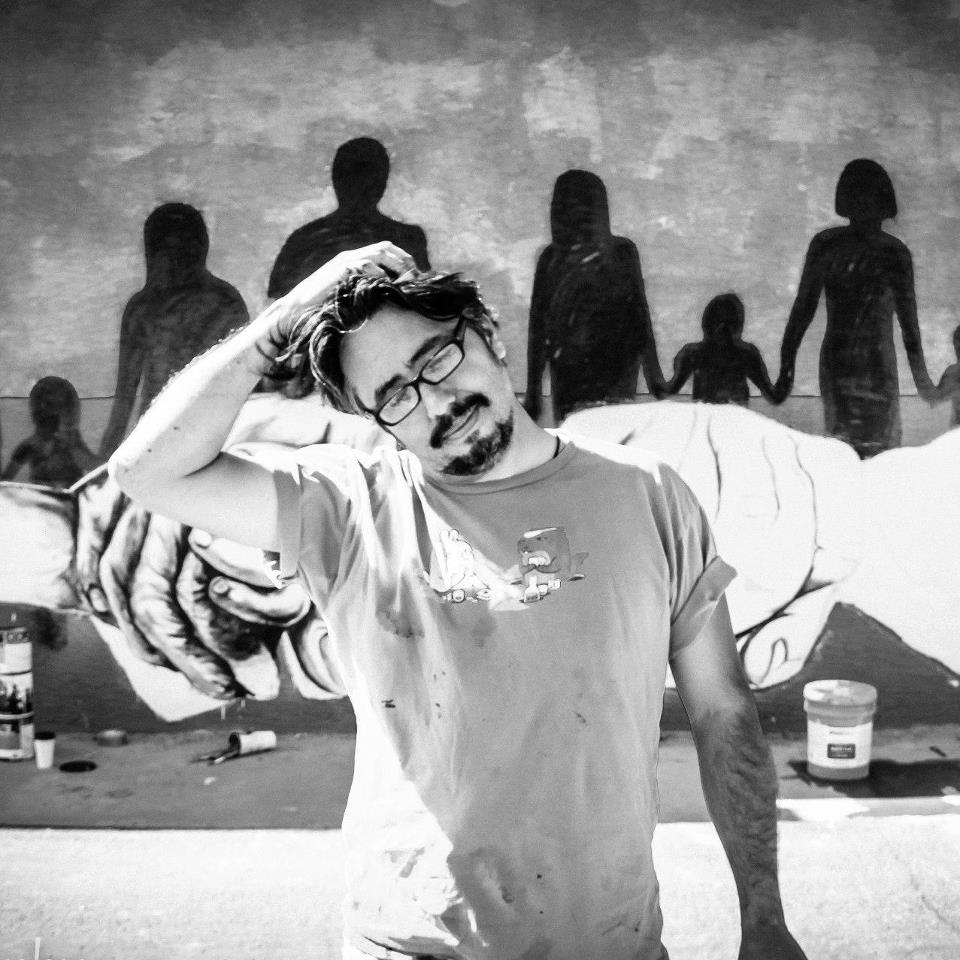
My offerings include:
- Hands-on visual arts workshops tailored to grade levels, focusing on foundational skills in drawing, painting, mixed media, composition, and creative problem-solving.
- Project-based residencies that engage students in artmaking, collaborative mural design, and comprehensive documentation from concept to completion.
- Arts integration modules aligned with New York State Learning Standards to enhance classroom instruction and foster deeper engagement.
- Professional development for educators on arts integration strategies and creative process facilitation to strengthen their capacity for maintaining arts-rich learning environments.
- Flexible delivery formats, including in-class workshops, multi-session residencies, assemblies, and virtual sessions.
My approach promotes student expression, creative confidence, and cultural awareness by connecting studio practice with academic inquiry. I am committed to equitable access to arts education and assisting schools in enriching their curricula through meaningful, student-centered artistic experiences.
The Tales of Scuba Steve

Scuba Steve will read and discuss portions of his book(s) with students, there will be video and photos to bring the books to life.
Scuba Steve will engage with the students, speaking and answering questions about what inspired him to become a professional scuba diver and environmental conservationist and how he was able to redirect this passion into writing books as well as his writing process.
Additional topics will include current issues facing the marine environment, its inhabitants, and what each of us, even children, can do to help.
Proceeds from book sales go to his “Read4Reefs” program to help ensure their sustainability and future.
Unique Game Show
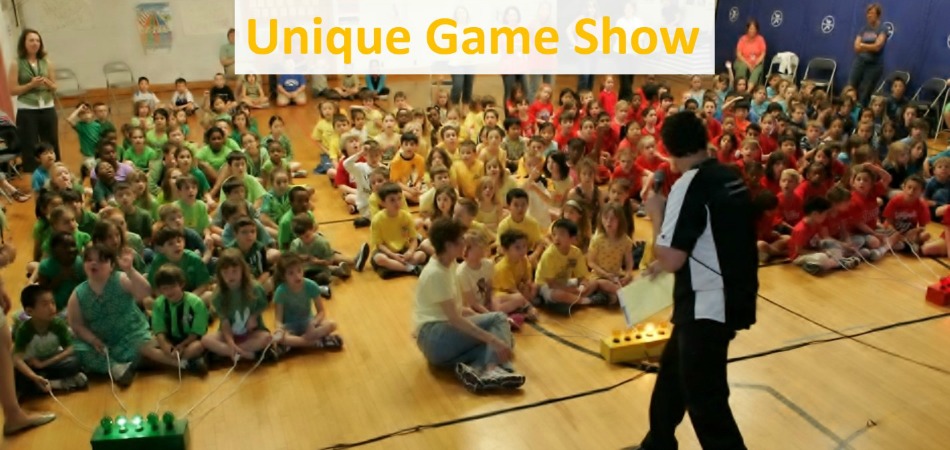
The Unique Game Show uses multi-media trivia and team-building activities to combine team spirit, character education, and curriculum enforcement into one program. This multi-purpose assembly is perfect for any subject because you can customize the program if you wish! The Unique Game Show can be customized based on your school’s curriculum. Math, Science, English, Reading, Social Studies and History, Drug and Alcohol Awareness, and Character Education are only a few subjects to which we can tailor the show. The most popular curriculum show, however, is built around the core subjects of history, science, English, and math. The entire assembly is divided into teams (red, yellow, blue and green.) The game begins with a curriculum-based reading question; followed by a video question about pop culture trivia with large-screen video projection and music enhancement. Each round finishes with an audio bonus question. Teams can generate points not only by answering correctly but also by demonstrating good sportsmanship and team spirit. The team-building part of the game includes activities such as physical challenges and team karaoke. This program is a great way for your students to work together while reinforcing their studies.
Matthew McElligott
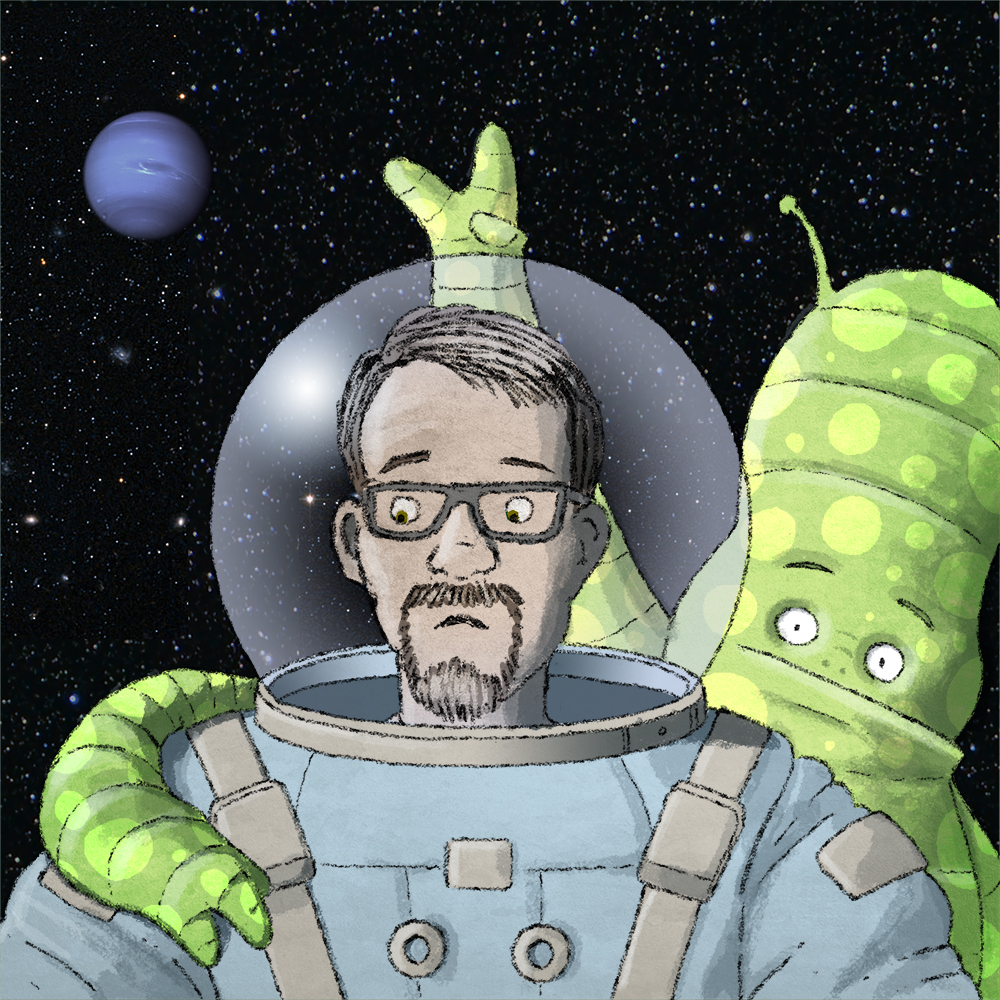
In Matt's programs he talks about the process of writing and illustrating picture books. Each talk focuses on one of his books and includes an interactive reading of the book, sharing background stories and talking a little bit about what authors and illustrators do, and an interactive demonstration of creating the illustrations. Matt will do either 3 auditorium sized or 4 library sized (smaller group) presentations per day. Four library presentations is highly preferred so Matt can better interact with students. Matt can also do an additional smaller group Q&A talk with select students (usually older kids who are interested in writing or drawing), such as a meeting over lunch or an "afternoon tea." Matt has a variety of educational and entertaining presentations suitable for students K through 6th grade, as well as presentations for parent's nights or literacy nights for an additional fee.
BubbleMania
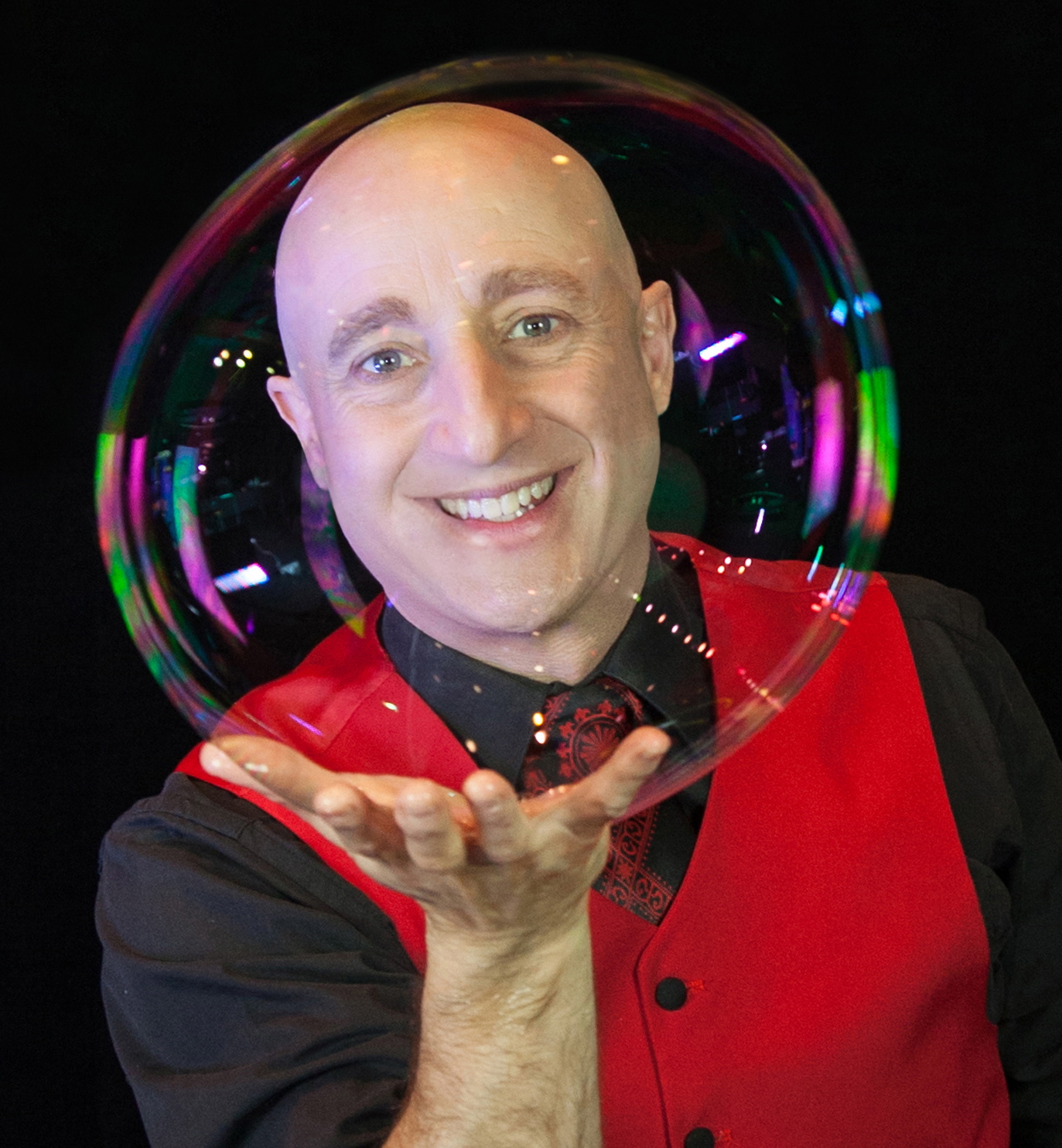
BubbleMania: Science, Art & Comedy! An extremely "pop"ular assembly that combines bubbling skills, clean humor and toe-tapping tunes with an exploration of the natural sciences to amaze, amuse and inspire. This show connects the dots between creativity and scientific know-how.
Students K-5 learn how bubbles form, how to use simple tools to create jaw-dropping bubble sculpture at home (spaceship, bubble cube, bubble disco ball), the science of bubble bursting, secret formulas and more. Includes eye-popping, artistic routines choreographed to jazzy music and a finale that finds a student trapped inside a giant bubble.
Developed by Casey Carle, international award-winning bubble manipulator with credits that include Cirque du Soleil, Sesame Street and The Smithsonian Institute. Thousands of shows presented at schools across New York & New England for two decades. Brains will whirl, eyes will go wide and jaws will drop for students and staff alike. Amaze, amuse and inspire with BubbleMania!
Ellen Sinopoli Dance Company
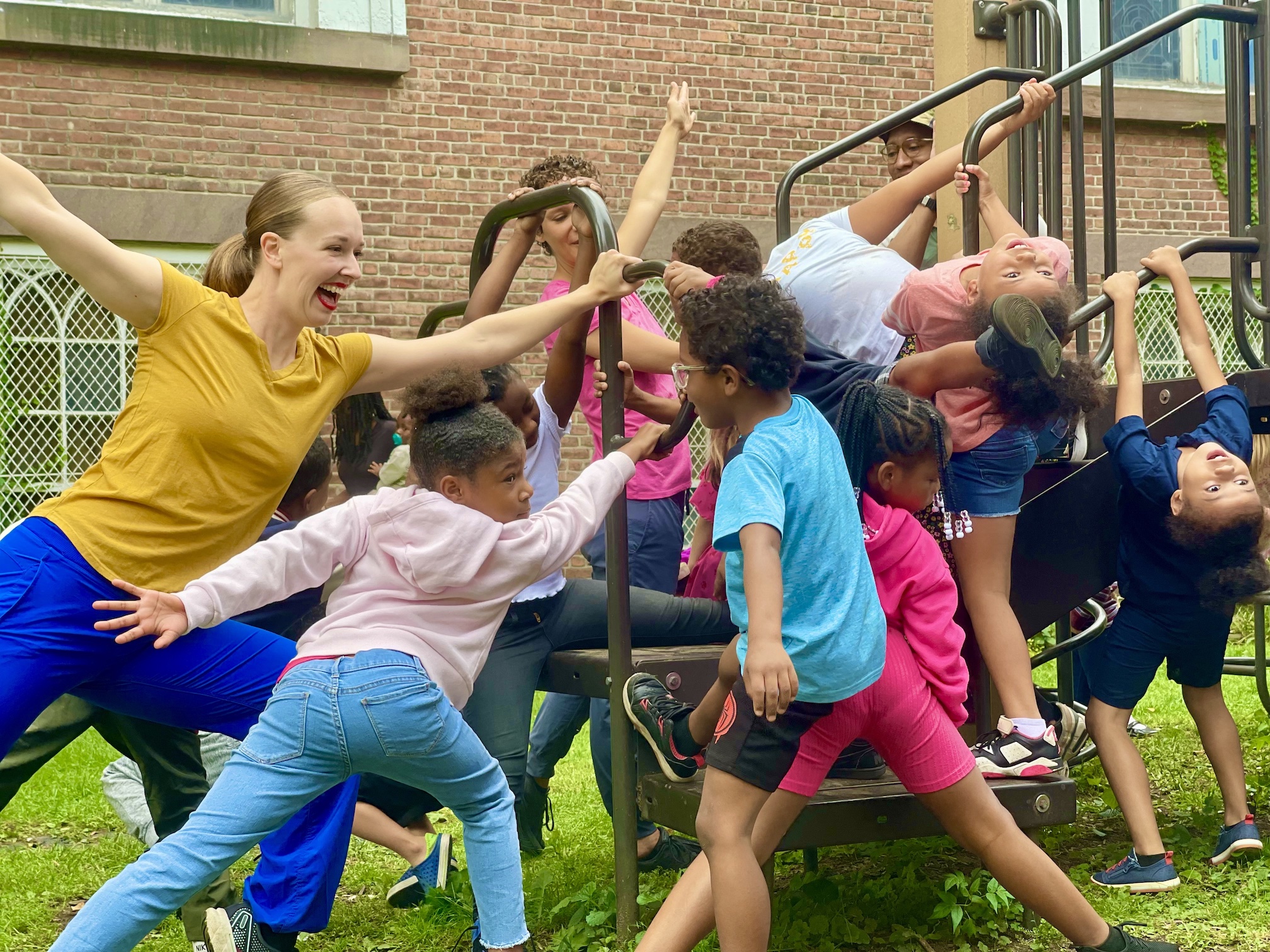
The ELLEN SINOPOLI DANCE COMPANY offers a range of workshops and performances for schools using dance narrative and technique to bring new meaning to literature, science, math and social studies. These are designed to offer young people the opportunity to experience the bravery of creativity and invention; to step into the realm of how one might learn differently and to see themselves in the most positive way possible. All programs can be customized to meet the unique needs of each school. ESDC’s participatory performances bring that same use of creativity and imagination for young people to enjoy. Story Hours allow children to see books through movement rather than just words, enhancing the learning adventure.
CREATIVE MOVEMENT WORKSHOPS:
(Grades: K-12) $225
Held on their own or in conjunction with an ESDC performance, workshops are designed to nurture the creative potential of each student and to encourage kinesthetic learning experiences while deepening their understanding of classroom curriculum. Led by 2 dancers and a musician, these workshops introduce children to the basic elements of dance: movement skills, body shapes/parts, space, time, force and form. Students explore theme-based ideas transforming themselves through movement choices to become bats, monkeys and jaguars from the rainforest; mimicking earthquakes exploding from the center to ripple out; experiencing the dynamics of reflection and refraction while moving through space. Students present a sampling of their activities for fellow classmates and families.
PARTICIPATORY AND REPERTORY PERFORMANCES SCIENCE IN MOTION: BRINGING SCIENCE TO LIFE
(Grades: K-5) $2000
An interactive program that brings the study of clouds, water, birds and their habitats to life. ESDC performs selections from its repertory as well as inviting students to join the dancers on stage to join in the exploration.
ESDC’s CHOREOPHYSICS
(Grades 9-12) $2500
Lecture/Demonstration, designed for High Schools students, is based on the laws of Physics.
IF BOOKS COULD DANCE! CHILDREN’S LITERATURE THROUGH DANCE
(Grades: K-5) $2000
Exploring literature, poetry, creativity, and visual art with movement, ESDC brings books to life. These captivatingly creative dances incorporate the stories of Kobi Yamada’s What Do You Do With an Idea?, poetry from Jack Prelutsky’s Behold the Bold Umbrellaphant, and Maurice Sendak’s Where the Wild Things Are.
UNDERCOVER PLAYGROUND: A SITE-SPECIFIC OUTDOOR PERFORMANCE
(Grades: K-5) $2000
This performance is created exclusively for your school playground with dancers utilizing the equipment in unexpected and fun-filled ways. This playful performance is outside and outside-of-the-box! The space offers each audience member a unique perspective and an opportunity to get up close and personal with the dance and the dancers. Live musical accompaniment!
DANCE BY CHANCE: A FUN, INTERACTIVE SHOW INTEGRATING MATHEMATICS
(Grades: 3-6) $2000
Mixing math with movement and matching learning to fun, we ask the audience math questions in an engaging way, leaving pencil and paper behind. The show teases their brain power, enhancing classroom learning in fun and unique ways.
SEE THE DANCE! HOW MOVEMENT CAN BE USED TO COMMUNICATE
(Grades: K-12) $2000
Favorite works from ESDC's repertory will be selected based on your school’s needs and interests, areas of study, or curriculum. This performance demonstrates how creativity and movement capture thoughts, ideas, actions, emotions, images, and concepts.
FROM THE MIND OF A SINGLE, LONG VINE ONE HUNDRED OPENING LIVES
(Grades:3-12) $2500
ESDC unites dance and visual arts through timeless stories inspired by African influenced wood sculptures created by craftsman Jim Lewis. The dance follows a community of people through the universal aspects of childhood, leadership, conflict, death, and healing from within. Students are encouraged to think about their role in the global community, working together to create a better place.
MOVEMENT STORY HOUR: LITERACY THROUGH MOVEMENT
(Grades: PreK-3) $125
Reading from the company’s library of children’s books, ESDC incorporates creative movement to enhance the reading experience. Children become a part of the story and find a love of reading!
David Hagerman, The Science Wizard
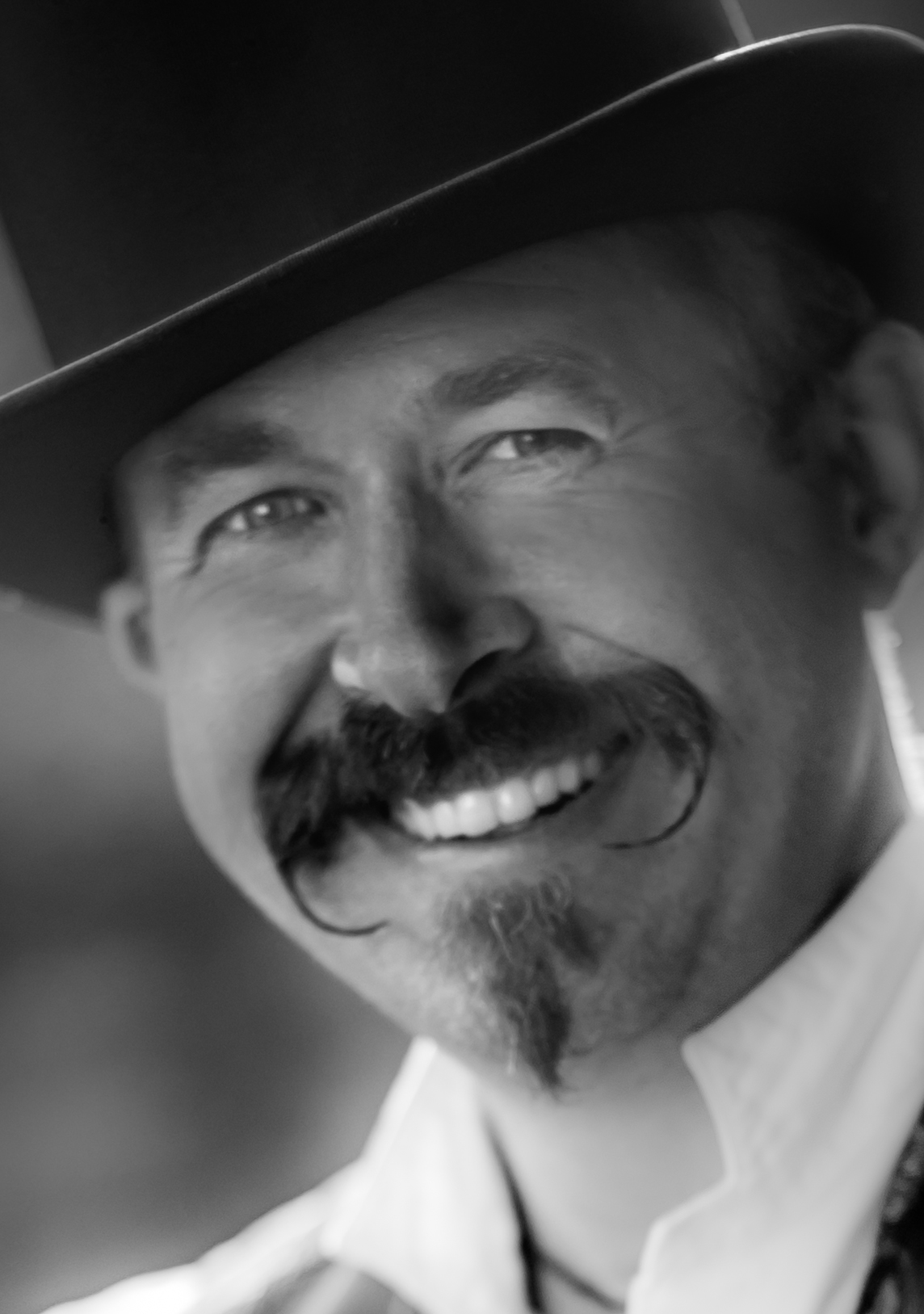
David Hagerman has been performing his math science assemblies for over 20 years. Though we are based in Branson, MO, David performs all over the country. Extreme Science 2.0 is a forty-five minute program that can be performed for grades K-12. Math-A-Magic and Sound of Science are also 45 minutes long and the same price as Extreme Science 2.0. Since Extreme Science is our most popular, I will put the description of it here. The show is catered to the age of the student audience. Most schools request multiple back-to-back shows, splitting the students into like-grades. The older students get a more advanced show with the science explained in more detail. For younger audiences, the visual nature of the show keeps their attention without talking over their heads.
This show is a large production including two performers, music and amazingly visual demonstrations:
700,000 Volt Van de Graaff generator (VDG): (one of the largest you can find), it creates 10-15 inch lightening bolts and more than enough static to raise hair
Vortex Cannons: creates flying rings of fog
Floating beach balls: thanks to the Bernoulli effect, we have flight
Video of the live in person performances:
VDG (2.5 minutes): https://www.youtube.com/watch?v=KhST0NcqmEc
Vortex Cannons (7 minutes): https://www.youtube.com/watch?v=WwXDdWSe_uE
For regular IN PERSON performances, the prices are as follows:
For one daytime performance per school site, it is $1475.
For two back-to-back daytime performances at the same school site, it is $1975 total.
For one morning and one afternoon (AM/PM) split performances at the same school site, it is $2275.00
For one evening performance per school site, it is $1575.
As a package deal; two afternoon performances and an evening family show at the same school site is $2700 ($800 savings).
If you have 2 or more schools that book, you EACH get 10% off. If 3 or more schools book, you EACH get 15% off.
David was invited to be on America's Got Talent for the 2021 season. His edited America's Got Talent performance: https://youtu.be/86FYGTmE1CU
Additional info:
Extreme Science: https://www.schoolscienceassemblies.com/extreme-science-school-assembly
Short promo video: https://www.youtube.com/watch?v=FnPrOCJnNcM
Archived testimonials date back to 1997: https://www.schoolscienceassemblies.com/references
The Boston Globe published this article on David Hagerman in their business section.
https://www.bostonglobe.com/business/2018/08/31/like-say-that-everything-percent-fake/os7VhPzfujVQrgmXpy99JK/story.html?event=event12
Performing over six hundred shows a year gives David a solid reputation that spans over 20 years of performing science assemblies nationally. We guarantee our show is one of the best you can find. If you disagree, no payment is due.
Jan Reynolds

Hello.... even though I hold several world records for climbing and skiing in the Himalaya, and even took a hot air balloon over Everest (we crashed, but made an award winning film!) and was on the U.S. Biathlon Team, and lived with an indigenous tribe on each continent, I still took time to make books, fun books!
My books have won Parent's Choice, Pick of the List, NCSS Notable Books for Social Studies, and so much more.
Any regions you study: rainforest, desert, mountains, and so on, we visit in my multi-media presentation. We cover standards for MANY subjects, and all national standards for geography and social studies. I leave you with a video, teaching guides, and activities to work with. Imagine large images from adventures around the world, and cultures on each continent, while I give personal information via story telling as an all school assembly... or divide the school into groups for a more personal Q and A to follow. I tailor my words to my audience and work with all k-12 students.
Emily Kalish and Kyle Walker
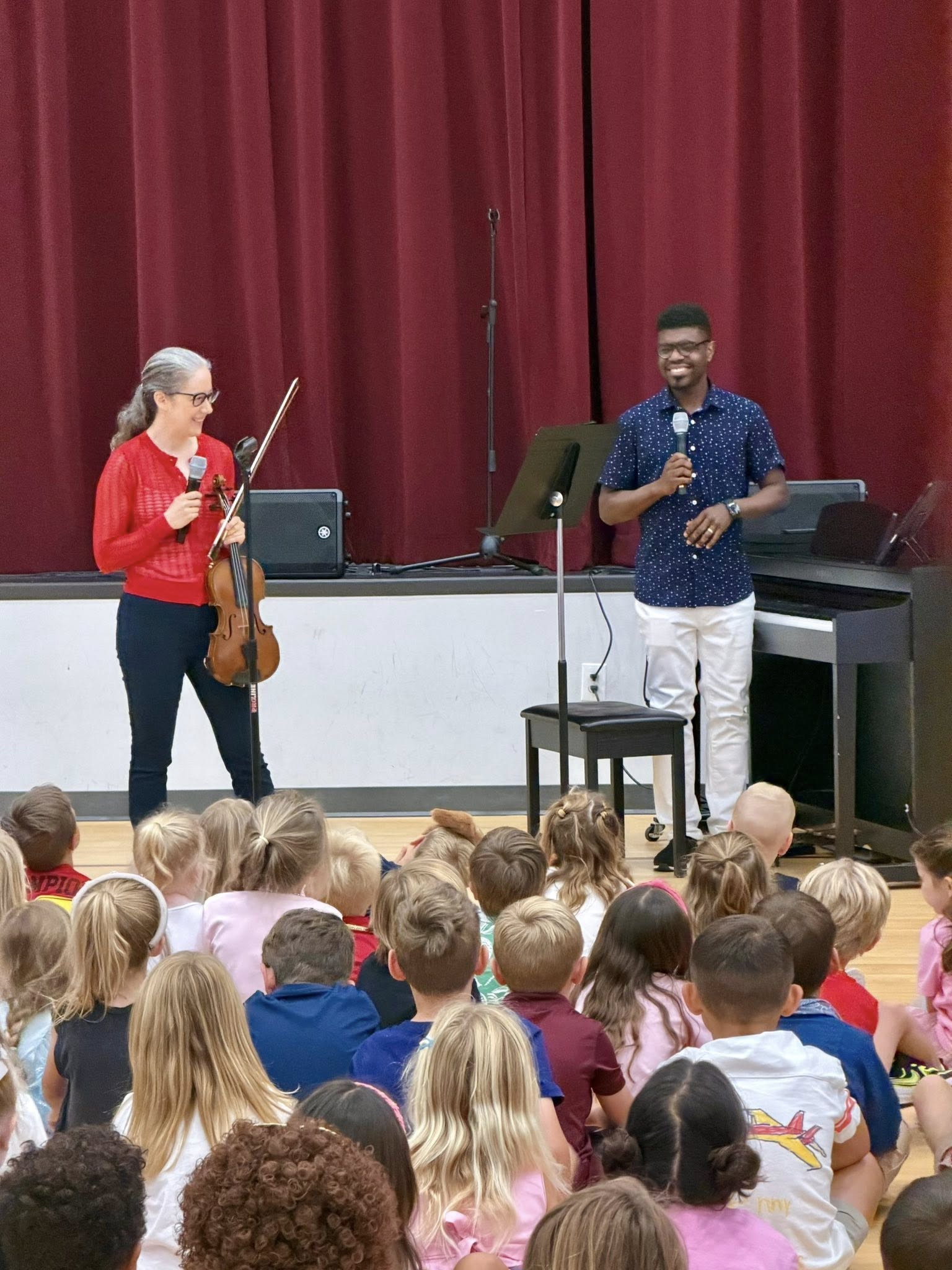
The Kalish/Walker Duo offers interactive educational violin/piano performances for kids from pre-K through high school. We currently have the following shows ready to go; these can be adapted to different formats or audiences, depending on your needs. We’re also excited to write new shows to connect music with any other curriculum or theme you want us to cover. Available for masterclasses, chamber music coaching, and sectionals as well.
A Whole Wide World of Musical Moods
In this interactive performance, children will respond to classical music through movement, coming up with stories or scenes that match the musical ambience, and making art in response to the music. Featuring music by important female composers and black composers, students are encouraged to believe that they too could become composers one day. Grade levels: K-2, Categories: Music, Music-Classical, Social-Emotional Learning, Diversity Equity and Inclusion
Musical Adventures in American History:
Thomas Jefferson, Violinist in Chief
Thomas Jefferson was not only the author of the Declaration of Independence and America’s 3rd president, he was also an accomplished violinist. Students will sing, dance and clap to the music that Jefferson himself knew and played. We’ll explore the musical form of “theme and variations,” with students identifying mood and emotion in music, and explore the American Revolutionaries’ fight for independence.
Grade levels: K-2, Categories: Music, Music-Classical, Social-Emotional Learning, History
Musical Adventures in American History: Thomas Jefferson, Revolutionary and Violinist
Students will explore music from the time of the Revolutionary War (from fiddle tunes that Thomas Jefferson actually played in the White House to beautiful ballads like Johnny Has Gone for a Soldier), as well as later musical selections that illuminate American history and the ideals of the Revolution. Students will identify changes of mood and emotion in a theme and variations and learn to create and listen for hemiola (changing between 6 8th notes being divided into 2 groups of 3 and 3 groups of 2.) Grade levels: 3-5. 6-8 Categories: Music, Music-Classical, Social-Emotional Learning, History
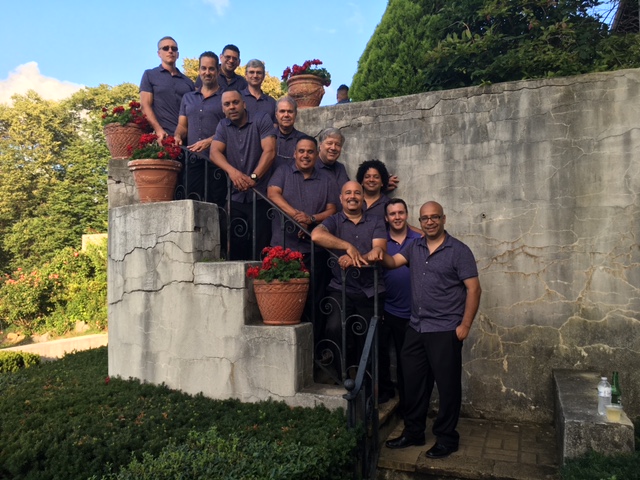
Alex Torres & His Latin Orchestra
For over 20 years, Alex Torres & His Latin Orchestra have been visiting schools, ranging from elementary to universities, performing on and demonstrating Afro-Caribbean instruments, roots and rhythms. They have provided a comprehensive and student tailored lecture/demo/hands-on program that has proven extremely successful and well received at the schools. These "assemblies" consist of three components. First the lecture component which provides knowledge, insight and answers the who, what, where and when. The second component is the demo. During the demo component the orchestra performs the Afro-Caribbean rhythms such as salsa, cha-cha & merengue. The third component is the "hands-on" component which is everyone's favorite part. Students are invited up on stage to perform a few bars of music with the musicians and become part of the band! The students realize many aspects of the music including that many of the Afro-Caribbean percussion instruments play an integral part in the music and also gain a sense of respect for the instruments and the performers. The orchestra has performed Arts In Education in over 100 schools, colleges and universities. For more information on our program, please call (518) 330-6917.